
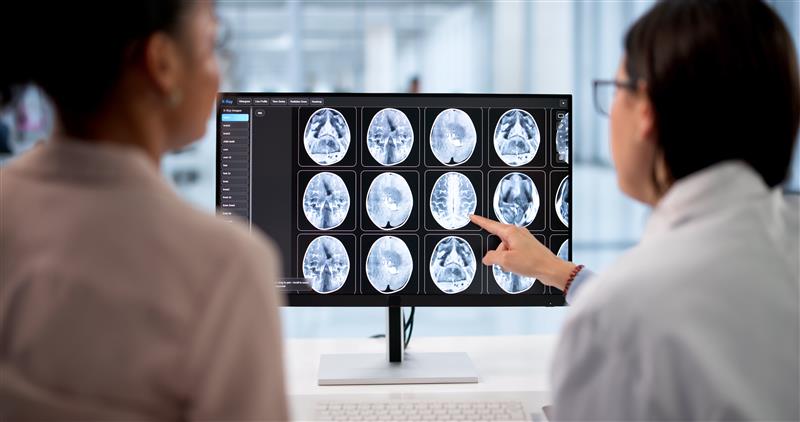
Neurological conditions like Parkinson’s and Alzheimer’s disease can be difficult to diagnose because symptoms overlap with other disorders or develop gradually. But new advanced imaging at Summit Health with tools like DaTscan and Vizamyl are changing that—giving physicians a clearer, more precise view of what’s happening in the brain and helping guide earlier, more confident care decisions.
These specialized scans, which are now available at Summit Health’s Clifton and Florham Park locations, offer detailed insights that support more accurate diagnoses and personalized treatment plans. Both DaTscan and Vizamyl provide information that cannot be seen on standard imaging like MRI or CT scans.
“These advanced imaging tools allow us to move beyond symptoms alone,” adds Komal Naik, DO, neurologist at Summit Health. “They help us make more confident, earlier diagnoses and connect patients to the most appropriate therapies sooner.”
What is a DaTscan?
A DaTscan is a type of imaging test that looks at dopamine activity in the brain. Dopamine is a chemical that helps control movement.
Parkinson’s disease is a progressive neurological condition that affects movement, often causing tremors, stiffness and balance issues—most commonly in older adults. In people with Parkinson’s disease, dopamine levels are reduced. This scan helps your doctor see how well those dopamine systems are functioning.
Why it matters:
- Helps confirm a diagnosis of Parkinson’s disease and may also be positive in another brain disorder known as Lewy body dementia
- Supports earlier and more accurate treatment decisions
“DaTscan gives us a functional view of the brain that we can’t get from traditional imaging,” explains Alexander Volvovsky, MD, radiologist at Summit Health. “By visualizing dopamine activity, we can provide neurologists with critical information to help clarify a diagnosis and guide next steps.
In the U.S, nearly 1 million people are living with Parkinson’s disease, and that number is expected to grow as the population ages—making earlier, more accurate diagnosis increasingly important for future care.
What is a Vizamyl scan?
A Vizamyl scan is a specialized PET scan that detects amyloid beta plaques—an important marker associated with Alzheimer’s disease. A form of dementia, Alzheimer’s disease impacts memory, thinking and behavior, primarily affecting aging adults and becoming more common with age.
These plaques build up in the brain over time and may be associated with memory loss and cognitive decline.
Why it matters:
- Helps determine whether Alzheimer’s disease may be the cause of symptoms
- Supports earlier and more accurate diagnosis of cognitive conditions
- Plays an important role in evaluating eligibility for newer anti-amyloid therapies
- Can help personalize treatment plans and monitor response to treatment over time
“For patients experiencing memory changes, having more diagnostic clarity is incredibly important,” says Dr. Naik. “Vizamyl allows us to better understand whether amyloid plaques are present, which directly impacts how we diagnose and treat Alzheimer’s and related conditions.”
Today, more than 7 million people in the U.S., aged 65 and older, are living with Alzheimer’s disease, with numbers expected to rise significantly in the coming years.
What to expect
Similar to MRI and CT scans, DaTscan and Vizamyl are non-invasive and painless. The main difference is that these scans use a small amount of a safe radioactive tracer, given through an IV, which helps highlight specific activity in the brain that standard imaging cannot detect.
After the tracer is administered directly in the office, there is typically a short waiting period to allow it to circulate through the body before the scan begins. During the scan, you’ll lie still on a table while the imaging is performed like other types of scans.
Most appointments take a few hours in total, including preparation and imaging time. Your care team will make sure you’re comfortable throughout the process, and your neurologist will review your results once they are available.
A more informed path forward
If you or a loved one is experiencing symptoms like tremors, movement changes, memory loss or cognitive decline, talk to your primary care physician or neurologist. Together, you can discuss if advanced imaging like DaTscan or Vizamyl may be a helpful part of your care plan.